

Direct answer: The best cookware for Indian kitchens is not one material but two or three working together. Cast iron handles high-heat work like dosas, searing, and tadkas. Ceramic handles everyday low to medium heat cooking like sabzi, eggs, and rotis. Stainless steel fills in for boiling, slow cooking, and acidic dishes. Most cookware disappointment in Indian kitchens comes from trying to use one material for everything. The right approach is matching the material to the cooking job.
TL;DR
-
No single cookware material handles every Indian dish well. The best Indian kitchens use two or three materials together.
-
Cast iron is the strongest performer for high-heat work: dosas, searing, tadka, browning.
-
Ceramic is the best everyday surface for low to medium heat cooking: sabzi, eggs, rotis, low-oil dishes.
-
Stainless steel is ideal for boiling, dal, acidic curries, and dishes where non-reactivity matters.
-
Non-stick at high heat is not recommended due to coating degradation. Reserve it for low-heat tasks if used at all.
-
Premium ceramic and cheap ceramic perform very differently. The category has been damaged by the cheap end of the market.
Why Most People Get Indian Kitchen Cookware Wrong
The most common buying mistake in Indian cookware is treating it as a single-material decision. People look for the one pan that does everything: dosa, sabzi, tadka, eggs, paneer, dal, and shallow frying. That pan does not exist. The result is either disappointment with a material that was never going to suit every job, or a kitchen full of compromise cookware that does nothing particularly well.
The better approach is to think about cookware the way professional kitchens do. Different materials for different jobs. A small set of well-chosen pans, each used for what it does best, will outperform a large set of generic pans that try to do everything. This is not about owning more cookware. It is about choosing cookware that fits how you actually cook.
For Indian kitchens specifically, this matters more than in many Western kitchens, because the range of cooking techniques is wider. Dosa cooking, tadka tempering, slow tamarind-based curries, paratha layering, sabzi sautéing, dal boiling, and shallow frying all have different ideal surfaces. A single pan cannot serve all of them well.
How to Decide What Cookware You Need
Before looking at specific materials, three questions answer most of the decision:
What do you cook most often? If most of your daily cooking is sabzi, dal, eggs, and rotis, you need a different setup than someone who makes dosas four times a week. The dominant cooking task should drive the dominant material choice.
How much heat do you cook on? Indian gas cooking tends toward high heat by default. If you cook on high gas flame consistently, cast iron handles it well. Ceramic does not. If you cook predominantly on low to medium heat, ceramic becomes a stronger everyday option.
Who else uses the cookware? A household where multiple people, including domestic help, use the same pans daily needs cookware that is forgiving of inconsistent handling. Some materials are more tolerant of this than others.
The right cookware set follows from honest answers to these three questions, not from chasing a single premium pan.
The Main Cookware Materials Compared
Cast Iron
Cast iron is the highest-performing material for high-heat Indian cooking. Dosa, searing, tadka, browning, and crisp paratha cooking are all areas where cast iron meaningfully outperforms most modern coated cookware. The thermal mass also produces more consistent cooking temperatures, which matters for dishes where heat fluctuation is the enemy.
The trade-off is handling. Cast iron is heavy. The handle gets hot. Raw cast iron requires seasoning over time. Slow-cooked acidic dishes like tamarind sambar or long tomato gravies can damage the seasoning layer on raw cast iron, though enamel-coated cast iron solves this.
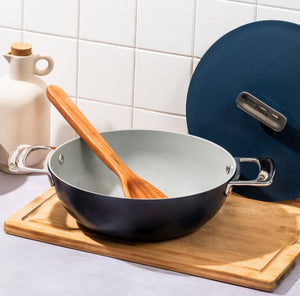
Modern variants like Ember's TitaniumClad combine the heat performance of cast iron with a non-reactive enamel surface. This removes the seasoning requirement and makes the material safe for acidic cooking, while keeping the heat behaviour cast iron is bought for. For households that want cast iron performance without the seasoning learning curve, coated cast iron is the simpler entry point.
Best for: dosas, tadkas, searing, browning, parathas, slow-cooked curries (enamel-coated only) Weaker for: light egg cooking, delicate sautéing, anyone with limited grip strength Longevity: decades with care
Ceramic
Ceramic is the best everyday cooking surface for low to medium heat work. Sabzi, eggs, low-oil cooking, sautéed vegetables, and most daily Indian home cooking sits squarely in ceramic's strength zone. It is also the cleanest surface from a chemical standpoint, made from mineral-based coatings that do not rely on fluoropolymer chemistry.
The trade-off is heat tolerance. Ceramic is not suitable for sustained high heat. Dosa cooking, in particular, damages ceramic coatings quickly. Thermal shock from cold water on a hot pan also degrades the coating. Ceramic asks for a slightly different set of habits than non-stick has trained most cooks for.
The category has also been damaged by the cheap end of the market. A ₹1500 ceramic pan from a mass-market brand is not the same product as a premium ceramic pan from a manufacturer with rigorous coating standards. Most negative reviews of ceramic cookware in India are about cheap ceramic where the coating failed in months. Premium ceramic, used correctly, lasts years.
Best for: daily low to medium heat cooking, eggs, sabzi, rotis, low-oil cooking Weaker for: dosas, sustained high heat, anyone who cooks predominantly on high gas flame Longevity: years with proper care
Stainless Steel
Stainless steel is the workhorse material that gets the least attention but earns the most respect once people use it correctly. It is non-reactive, durable, and handles acidic cooking better than almost any other material. For dal, sambar, tamarind-based curries, and long-simmered dishes, stainless steel is often the right choice.
The trade-off is the learning curve. Stainless steel is not non-stick by default. Used correctly, with proper preheating and the right amount of oil, food releases cleanly. Used incorrectly, it can be frustrating, particularly for eggs and delicate proteins. Triply construction (stainless steel with an aluminium or copper core) addresses the heat distribution issues that single-layer stainless steel can have.
Best for: dal, acidic curries, boiling, slow cooking, sauces, anything where non-reactivity matters Weaker for: dosas, eggs (without practice), anything requiring a non-stick surface Longevity: decades, often a lifetime
Non-Stick (Teflon-coated)
Non-stick cookware is the most familiar category in Indian kitchens, mostly because of its convenience for eggs and low-oil cooking. The concern is heat. Teflon-coated non-stick begins to degrade above approximately 260 degrees Celsius, releasing fumes that have raised health concerns. Indian gas cooking can reach those temperatures quickly, particularly for dosa, tadka, and searing work.
This makes non-stick a difficult fit for Indian cooking patterns. It performs well for the dishes it suits (low-heat eggs, gentle sautéing) but is not recommended for high-heat work that defines much of Indian cooking. The pans also degrade faster than ceramic or cast iron, even with careful use.
For households that already own non-stick, the practical advice is to reserve it for low-heat tasks and avoid using it for dosa, tadka, or any cooking that requires high flame. For new purchases, ceramic generally serves the same use cases with fewer heat-related concerns.
Best for: low-heat egg cooking, gentle sautéing (with health caveats) Weaker for: dosas, tadka, searing, anything requiring high heat Longevity: one to three years typically
Enamelled Cast Iron
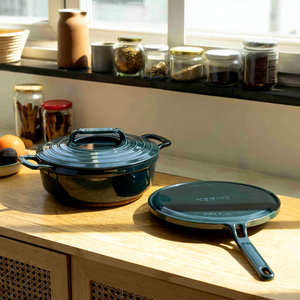
Enamelled cast iron combines the heat behaviour of cast iron with a non-reactive coating that does not require seasoning. The result is a material that works well for slow cooking, braising, and acidic curries while still handling reasonable heat work. It is heavy, premium-priced, and often beautiful enough to serve in.
The category has grown in India recently, with brands building credibility around enamel cast iron as a healthy, durable alternative to both raw cast iron and modern non-stick. The trade-off is weight, price, and the limitation that enamel cast iron cannot handle the same extreme high heat as raw cast iron without risking the enamel.
Best for: slow cooking, braises, acidic curries, anything where heat retention and non-reactivity both matter Weaker for: very high heat work, weight-sensitive cooks Longevity: decades
Cooking by Indian Dish: What Works Best
This table reflects what each material genuinely handles well, where it is workable but not ideal, and where it should be avoided. The entries marked "Not recommended" are use cases where the material is the wrong choice regardless of brand.
|
Dish or Technique |
Cast Iron |
Ceramic |
Stainless Steel |
Non-Stick (Teflon) |
|
Dosa |
Excellent |
Not suitable |
Workable with skill |
Not recommended |
|
Roti and paratha |
Excellent |
Good |
Workable |
Workable |
|
Sabzi (everyday vegetables) |
Good |
Excellent |
Good |
Workable |
|
Tadka tempering |
Excellent |
Use low heat only |
Workable |
Not recommended at high heat |
|
Eggs |
Good once seasoned |
Excellent |
Possible with practice |
Easy |
|
Dal and slow-cooked lentils |
Workable |
Workable |
Excellent |
Workable |
|
Tamarind and tomato curries |
Avoid raw cast iron; enamel fine |
Good |
Excellent |
Workable |
|
Deep frying |
Excellent |
Not recommended |
Excellent |
Not recommended |
|
Searing and browning |
Best choice |
Not suitable |
Good (triply) |
Not recommended |
|
Shallow frying paneer |
Good |
Excellent |
Workable |
Easy at low heat |
The single most useful observation from this table: there is no single column where every entry says "excellent." That is the point. The right kitchen uses multiple materials to cover the range of Indian cooking.
What Makes High-Quality Ceramic Cookware Different
Most negative ceramic reviews in India are about ceramic that should never have been positioned as quality cookware in the first place. The price tier matters because the underlying product differs meaningfully.
Coating composition. Premium ceramic uses higher-grade mineral compounds in the coating formulation. Cheap ceramic uses lower-grade fillers that look identical on the surface but behave very differently under heat and daily use.
Coating thickness. Premium ceramic applies the coating in multiple layers to a thickness that supports years of daily use. Cheap ceramic uses thinner coatings that chip and degrade within months, particularly under Indian cooking conditions.
Manufacturing precision. Ceramic coating application requires precise control over temperature, humidity, and curing time. Mass-market manufacturing tolerates inconsistencies that show up as performance variation between pans, even within the same batch.
Quality control. Premium manufacturers test their coatings against international safety and durability standards. Cheap ceramic often skips this layer, which is how lead and cadmium have occasionally been found in unverified ceramic products.
Ember's ceramic cookware is manufactured in Italy at a facility with a longstanding history in ceramic coating production. Italian ceramic manufacturing has the deepest accumulated expertise in coating formulation and application, reflecting decades of refinement in the supply chain and skill base. This translates to more consistent coating thickness, more refined mineral formulations, and more reliable quality control than mass-market ceramic manufacturing can typically achieve. The Arcilla coating used on Ember's ceramic range is made from water, clay, and natural mineral ingredients, independently tested and certified by SGS, and free of PTFE, PFOA, PFAS, lead, and cadmium.
This level of differentiation is real, but it has a cost. Premium ceramic cookware costs more than mass-market ceramic. The case for paying that difference depends on how much you cook, how long you want the cookware to last, and whether you care about the underlying material quality.
How to Choose Your First Upgrade
For households moving away from older non-stick or building a new cookware set, the right starting point depends on what you cook most.
If you cook mostly low to medium heat dishes (sabzi, eggs, daily vegetable cooking): Start with a ceramic frying pan or kadai. It will cover most of your daily cooking and is the easiest transition from non-stick. The main adjustment is learning to cook on lower heat and letting the pan cool before washing.
If you cook dosas regularly: Start with cast iron. A good cast iron tawa is non-negotiable for dosas. Ceramic and non-stick cannot replace it.
If you cook a lot of acidic curries or slow-cooked dishes: Start with stainless steel or enamel cast iron. Both handle long acidic cooking better than raw cast iron, and stainless steel is the more affordable entry point.
If you cook everything, frequently: Build a small set of two or three pans across different materials. A ceramic frying pan for everyday, a cast iron tawa for high-heat work, and a stainless steel pot for dal and slow cooking covers most Indian home cooking with room to grow.
The mistake to avoid is buying one expensive pan and expecting it to do everything. Even the best single pan will disappoint somewhere.
FAQ: Best Cookware for Indian Kitchens
What is the safest cookware for Indian cooking?
Quality ceramic cookware is among the safest options because the coating is mineral-based and does not contain PTFE, PFAS, or PFOA. Stainless steel and enamel cast iron are also safe and non-reactive. Raw cast iron is safe and adds trace iron to food, which is generally beneficial. Non-stick cookware raises more questions, particularly at the high heat that Indian cooking often requires.
Is ceramic cookware actually good for Indian cooking?
Yes, for the right tasks. Ceramic handles sabzi, eggs, low-oil cooking, and everyday low to medium heat cooking very well. It is not suitable for dosa, sustained high heat, or thermal shock. The category has been damaged by cheap ceramic pans that fail quickly, but premium ceramic used correctly performs well for years.
Why is premium ceramic cookware so expensive?
Premium ceramic costs more because the coating formulation, application process, and manufacturing standards are meaningfully different from mass-market ceramic. The coating is thicker, applied in multiple layers, and tested to international safety standards. Manufacturing in Italy or other established ceramic centres adds further cost but reflects deeper expertise. The price difference is justified if the cookware lasts five to ten times longer than cheap alternatives, which it generally does when used correctly.
What is the difference between cast iron and TitaniumClad cast iron?
Traditional cast iron is raw or pre-seasoned iron that builds a non-stick surface through accumulated seasoning over time. TitaniumClad is cast iron coated with a titanium-reinforced enamel at the factory, which provides a built-in non-reactive surface that does not require traditional seasoning and is safe for acidic cooking. Traditional cast iron rewards long-term seasoning habits. TitaniumClad is ready to use on day one and easier to maintain for households with multiple users.
Can one pan do everything in an Indian kitchen?
No. Indian cooking covers too wide a range of techniques and temperatures for any single material to handle well. The most common mistake is buying one premium pan and expecting it to cover dosa, sabzi, dal, and tadka equally well. The better approach is two or three pans across different materials, each used for what it does best.
Is non-stick cookware safe for Indian cooking?
It depends on heat level. Teflon-coated non-stick begins to degrade above approximately 260 degrees Celsius, which is reachable on a high gas flame within minutes. For low-heat tasks like eggs and gentle sautéing, non-stick is workable. For dosa, tadka, searing, or any high-heat Indian cooking, it is not recommended.
How long should good cookware last?
Cast iron and enamel cast iron typically last decades with reasonable care. Stainless steel often lasts a lifetime. Premium ceramic lasts years when used correctly, typically five years or more for the coating's non-stick performance. Non-stick cookware generally lasts one to three years before the coating degrades. The longevity case for cast iron, ceramic, and stainless steel is strong over time, even at higher upfront prices.
Where is Ember cookware made?
Ember's ceramic cookware is manufactured in Italy at a facility with a longstanding history in ceramic coating production. Italian ceramic manufacturing has the deepest accumulated expertise in coating formulation and application. Products are designed by Box Clever, the California design agency behind Caraway cookware and the Away luggage brand, with the design process informed by Indian kitchen testing.
Bottom Line
The best cookware for Indian kitchens is not a single pan. It is a small, considered set of materials, each chosen for the cooking jobs it handles well. Cast iron for high-heat work. Ceramic for everyday low to medium heat cooking. Stainless steel for boiling, dal, and acidic dishes. Together they cover the range of Indian cooking better than any single material can on its own.
The mistake most buyers make is trying to find the one perfect pan. The better question is: which two or three pans together will cover how you actually cook? Answer that honestly, and the rest of the decision becomes simpler.
Premium versions of these materials cost more than mass-market versions. The case for paying the difference is the case for cookware that lasts years rather than months, performs more consistently, and is made from materials whose composition you can actually verify. That case is strongest for daily cooks, weakest for occasional ones. For households that cook every day on Indian-kitchen-typical heat, the long-term math favours fewer, better pans.
