

Best Cookware for Low-Oil Indian Cooking
Direct answer: Quality ceramic cookware is the most practical choice for daily low-oil Indian cooking. The mineral-based non-stick surface releases food cleanly with as little as a teaspoon of oil for many dishes, which makes the transition from higher-oil cooking much easier. Well-seasoned cast iron and triply stainless steel both work for low-oil cooking but ask more of the cook on technique. Non-stick (Teflon-coated) cookware also cooks well with less oil but is less ideal for high-heat Indian cooking patterns. For many households trying to reduce oil meaningfully, the right ceramic pan removes enough daily friction to make the habit easier to maintain.
TL;DR
-
Ceramic is the easiest material to cook low-oil Indian food on. The release performance covers for technique gaps that other materials expose.
-
Triply stainless steel works for low-oil cooking with proper preheating and timing, but the learning curve is real.
-
Cast iron handles low-oil cooking well once the seasoning has built up, particularly for tadka and sautéing.
-
Non-stick can do low-oil cooking but is less ideal for high-heat Indian cooking patterns.
-
The cookware matters, but so does the technique. Better cookware makes the technique easier.
-
Most well-equipped low-oil Indian kitchens use ceramic as the daily pan with stainless steel for slow-cooked acidic dishes.
Why Cookware Matters More for Low-Oil Cooking Than People Realise
The most common reason people abandon low-oil cooking is not lack of discipline. It is the daily frustration of food sticking. A sabzi made with two teaspoons of oil instead of two tablespoons on a stainless steel pan often ends with onions burnt in spots, vegetables stuck to the surface, and a pan that takes ten minutes to scrub clean. The cook makes that compromise once or twice, gives up, and goes back to using more oil.
The cookware that supports low-oil cooking solves this problem. A pan that releases food cleanly at one teaspoon of oil makes the technique sustainable rather than painful. The same dish that frustrated the cook on stainless steel comes out without sticking on ceramic. The next time they cook, they reach for the ceramic pan and use less oil without thinking about it.
This is why the cookware conversation matters so much for low-oil cooking. The dietary advice ("use less oil") is straightforward. The implementation is harder than it sounds without the right tools. A bottle of cooking oil is cheap. A pan that supports lower oil use over thousands of meals pays back across years.
What "Low-Oil Cooking" Actually Means in an Indian Context
Indian cooking has a wide range of oil habits. Traditional preparations can use significant amounts of oil for flavour, texture, and shelf-life reasons. Modern Indian home cooking has trended toward less oil over the past two decades, particularly in urban households focused on health.
For most contemporary Indian kitchens, "low-oil cooking" means roughly:
-
One to two teaspoons of oil for daily sabzi (depending on quantity and pan size), instead of one to two tablespoons
-
Minimal oil for rotis and parathas (some households use ghee or skip added fat entirely)
-
Smaller amounts of oil for tadka, just enough to bloom the spices
-
Lighter oil use in everyday cooking, with traditional oil amounts reserved for special dishes
This is different from "no-oil cooking," which is harder to do well in Indian cuisine and often results in less satisfying food. The realistic goal for most health-conscious Indian households is meaningful reduction, not elimination.
The cookware that supports this kind of cooking has one main job: release food well at the lower end of the oil range. A pan that works at two tablespoons of oil but fails at one teaspoon does not support the goal. A pan that works at one teaspoon makes the lower oil amount sustainable.
The Cookware Materials Ranked for Low-Oil Indian Cooking
Here is how each material performs for the specific goal of reducing oil in daily Indian cooking.
Ceramic. The strongest performer for low-oil daily cooking. The mineral-based coating releases food cleanly with one teaspoon of oil for many dishes on a small to medium pan. Sabzi, eggs, sautéing, and gentle frying all work at minimal oil levels. The transition from higher-oil cooking is easier on ceramic than on any other material.
Triply stainless steel. Workable for low-oil cooking with technique. The right preheating, the right timing for adding food, and the right amount of moisture management can make stainless steel release food well at lower oil levels. The learning curve is real, and most cooks need a few weeks of practice before low-oil cooking feels comfortable on stainless steel.
Cast iron (well-seasoned). Handles low-oil cooking well once the seasoning has built up over months of use. New cast iron with limited seasoning needs more oil to prevent sticking. Mature cast iron (a year or more of regular use) releases food at low oil levels comparable to ceramic. The constraint is the time required to build that seasoning.
Non-stick (Teflon-coated). Cooks well at low oil levels by design. The fluoropolymer coating releases food at almost any oil amount. The constraint is the high-heat question. Common Indian gas-flame cooking patterns often push non-stick beyond its safe temperature range, which limits its appeal for households cooking traditional Indian food. For low-heat eggs and gentle sautéing, non-stick works. For sabzi at typical Indian heat levels, the trade-offs become more relevant.
Single-layer aluminium. Not recommended. Poor heat distribution causes hot spots that burn food at low oil levels. Aluminium also reacts with acidic ingredients common in Indian cooking. There is no scenario where single-layer aluminium is the right choice for low-oil Indian cooking.
Uncoated copper. Excellent heat control but reacts with acidic foods and requires regular maintenance. Most uncoated copper cookware is also expensive enough that the price-to-value ratio does not match what ceramic or stainless steel offers for everyday use.
The clearest answer for most Indian households is ceramic as the primary low-oil pan, with stainless steel handling the slow-cooked dishes that ceramic does not suit.
Ceramic: Why It Works Especially Well for Low-Oil Daily Cooking
Three reasons ceramic is particularly well suited to low-oil Indian cooking.
The release performance is forgiving. Food slides off the surface even when the oil amount is reduced significantly. A sabzi that needed two tablespoons of oil on stainless steel often releases cleanly on ceramic with one teaspoon. The cook can experiment with less oil without the immediate punishment of stuck food.
The heat distribution is even. Hot spots are what burn food at low oil levels. Ceramic spreads heat evenly across the cooking surface, which means the low oil that is present stays where it needs to be rather than concentrating in one spot and burning.
The cleanup stays fast even at low oil. Stainless steel and cast iron cookware washed after low-oil cooking often needs extra scrubbing because the small amount of oil that should have prevented sticking was not enough. Ceramic remains easy to clean across the oil range, which removes one of the daily frictions of low-oil cooking.
Ember's ceramic cookware is manufactured in Italy. Italian ceramic manufacturers have a long history in the category, which tends to produce more consistent coatings than mass-market manufacturing. The Arcilla coating is mineral-based and independently tested and certified by SGS, free of PTFE, PFOA, PFAS, lead, and cadmium. For buyers specifically focused on low-oil cooking, the coating quality matters because the release performance at low oil levels depends on the surface being intact and uniform.
This is not to say that any ceramic brand will deliver these results. Cheap ceramic with thin coatings often performs well for a few months and then loses the release performance that made low-oil cooking work in the first place. The case for paying more for ceramic is strongest in low-oil cooking households, where coating quality directly affects whether the dietary change is sustainable.
Stainless Steel: Workable but Harder
Stainless steel can do low-oil cooking. The technique matters more than it does on ceramic.
The key adjustment is preheating. A stainless steel pan needs to be properly hot before food is added. The water droplet test is the standard check: a drop of water on the pan should form a ball and roll across the surface (the Leidenfrost effect), not sizzle and evaporate. If the water sizzles, the pan is not hot enough and food will stick. If the water rolls, the pan is at the right temperature for the food to release as it cooks.
The right amount of oil also matters. Counterintuitively, stainless steel needs a film of oil to prevent sticking, but not a pool of oil. A teaspoon of oil swirled across a properly preheated pan creates the right surface for food to release. More oil than that defeats the purpose. Less oil than that risks sticking.
For experienced cooks who have developed the timing, stainless steel works well for low-oil cooking and offers advantages ceramic does not (browning, fond development, longevity, induction compatibility). For cooks newer to the technique, the learning curve can be discouraging, and the daily frustration of getting it wrong sometimes leads people back to higher-oil cooking.
Triply stainless steel (with an aluminium or copper core) is the right tier for serious low-oil cooking. Single-layer stainless steel has too much heat unevenness to be reliable at low oil levels.
Cast Iron: Situational, Especially Well-Seasoned
Cast iron is excellent for low-oil cooking once it has built up significant seasoning. The polymerised oil layers create a non-stick surface that handles food release well at minimal oil amounts.
The catch is the time it takes. A new cast iron pan with only factory seasoning often requires more oil than ceramic to prevent sticking. Mature cast iron with a year or more of regular use can release food at low oil levels comparable to ceramic. The seasoning is what does the work, and the seasoning takes time to develop.
For households already cooking on well-seasoned cast iron, low-oil cooking is straightforward. The pan supports the goal naturally. For households buying cast iron specifically for low-oil cooking, there is a transition period where the pan does not yet perform at its best, and the cook either needs to use more oil during that period or accept some sticking.
Cast iron's other advantages for Indian cooking (heat retention, high-heat tolerance, dosa capability) make it valuable in a kitchen even if it is not the primary low-oil pan. The typical pattern is ceramic for daily low-oil cooking, cast iron for high-heat work that benefits from the thermal mass.
Coated cast iron (TitaniumClad, enamel) handles low-oil cooking differently. The non-reactive coating provides immediate release performance comparable to a mature seasoning, without the seasoning learning curve. For households wanting cast iron's benefits without the seasoning commitment, coated cast iron is a reasonable choice for low-oil cooking.
Non-Stick: Less Ideal for High-Heat Indian Cooking
Non-stick cookware was designed for low-oil cooking. The release performance at minimal oil levels is excellent.
The constraint is heat. Teflon-coated non-stick begins to degrade above the commonly cited threshold of approximately 260°C, releasing fumes that have raised health concerns. Common Indian gas-flame cooking patterns reach those temperatures within minutes for tasks like preheating, tadka, and sautéing at typical heat levels.
For low-heat tasks (eggs at gentle heat, soft scrambled paneer, gentle reheating), non-stick is fine and the low-oil performance is genuinely good. For Indian cooking that involves higher heat (which is most everyday cooking), non-stick is being used outside its safest conditions.
The practical position for most Indian households is to limit non-stick to the genuinely low-heat tasks where it shines and use ceramic or other materials for the rest of the cooking. The full discussion of non-stick safety is covered in the standalone article on whether non-stick is dangerous, which is the right reference for any reader wanting more depth than this article provides.
The Indian Dishes That Benefit Most From Low-Oil Cookware
For specific Indian dishes, the cookware choice matters more in some cases than others.
Sabzi. This is where low-oil cookware does its most useful work. Daily vegetable preparations cook well at one teaspoon of oil on ceramic for many sabzis. Bhindi, jeera aloo, cabbage, beans, and most other vegetable dishes benefit directly from the release performance.
Eggs. Bhurji, omelettes, scrambled eggs all cook well at low oil on ceramic. Stainless steel can do eggs at low oil with practice, but ceramic makes it easier.
Sautéed paneer. Pan-fried paneer cubes can be done at minimal oil on ceramic. On stainless steel, the paneer often sticks unless more oil is used. On cast iron with mature seasoning, paneer works well at low oil.
Tadka and tempering. Tadka requires oil to bloom the spices, but the amount can be reduced significantly. Ceramic supports lower-oil tadka at medium heat. Cast iron handles tadka well at any oil level.
Rotis and parathas. Many low-oil households cook rotis with no added fat at all. Ceramic flat pans handle this well. For ghee-brushed rotis or lightly oiled parathas, both ceramic and cast iron work.
Onion-tomato masala. The foundation of many Indian dishes benefits from low-oil cooking on ceramic. The aromatics caramelise cleanly even at minimal oil levels.
Dishes that need more oil regardless of cookware. Some Indian dishes are designed around oil as a flavour and texture element. Tadka for sambhar uses more oil for a reason. Tarka dal benefits from a generous tadka. Pickling and certain regional preparations require specific oil amounts for the dish to work. The goal of low-oil cooking is not to eliminate oil from all dishes but to use less in the everyday cooking where oil quantity is more habit than necessity.
How to Actually Cook With Less Oil
The cookware does part of the work. Technique does the rest. A few specific changes that help:
Heat the pan before adding oil. A warm pan distributes oil more evenly than a cold pan. The teaspoon of oil added to a properly warmed ceramic pan covers more surface area than the same amount added to a cold pan.
Use a brush or spray for oil application. A few drops applied with a silicone brush distributes oil more evenly than a glug from the bottle. The same amount of oil covers more pan area and prevents the puddle-in-one-spot problem.
Add aromatics to the oil immediately. Letting onions, garlic, or spices hit oil that has just spread across the pan helps the oil cling to the food rather than evaporate from the pan surface.
Use water or stock to deglaze. When food starts to stick, the instinct is to add more oil. The better move is to add a tablespoon of water or stock, which lifts the food off the surface without adding fat.
Cover the pan when steaming-style cooking helps. Many sabzi dishes benefit from a brief period of covered cooking, where the steam from the vegetables themselves does work that oil would otherwise do.
Build flavour with spices rather than oil. Properly bloomed spices contribute flavour intensity that compensates for reduced oil quantity. A small amount of oil with well-bloomed spices often tastes better than more oil with under-bloomed spices.
Accept that low-oil cooking takes practice. The first few weeks of cooking with significantly less oil involves some adjustment in cooking time, texture expectations, and technique. The cookware supports the change but does not eliminate the learning period.
What Changes When You Reduce Oil
Low-oil cooking is not only a sticking problem. It also changes the way food tastes and feels, and a balanced article should acknowledge what those changes actually are.
Browning is reduced. Oil supports the Maillard reaction that creates the deep brown colour and flavour in caramelised onions, seared paneer, and crisp parathas. At lower oil levels, browning is less intense. For dishes where the brown is part of the dish (jeera aloo with crisp edges, deeply caramelised onions for a curry base), the reduced oil can change the result meaningfully.
Mouthfeel is lighter. Oil contributes to the richness and coating sensation of cooked food. Reducing oil makes the dish lighter on the palate, which many cooks find positive over time but which can feel less satisfying in the first few weeks of the transition.
Spice blooming requires more attention. Spices need fat to release their full flavour during tempering. At lower oil levels, the spices need to be in contact with the small amount of oil for slightly longer, and the heat needs to be controlled carefully to avoid burning. This is part of why properly bloomed spices matter more in low-oil cooking than in higher-oil cooking.
Crispness is harder to achieve. Crisp parathas, deeply browned paneer, and shallow-fried foods all rely on enough oil to create a crisp surface. Low-oil cooking can produce soft, well-cooked food but not the crisp textures that come from higher oil amounts. For households that value crisp textures in specific dishes, the answer is usually to keep the higher oil amounts for those dishes rather than to insist on low-oil cooking across the board.
Regional and traditional dishes may need their original oil amounts. Many Indian dishes are designed around specific oil quantities for reasons that are not arbitrary. Hyderabadi biryani, Goan vindaloo, certain pickle preparations, and some regional sweets use the oil they use because that is what makes the dish work as intended. Reducing oil in these cases changes the dish, not just the calorie count. The realistic approach is to identify the daily cooking where oil quantity is habit rather than necessity and to keep traditional oil amounts for the dishes where the oil is part of the dish.
The honest position is that low-oil cooking works very well for most everyday Indian food and works less well for some specific dishes where oil is doing flavour or texture work. Knowing the difference helps the cook avoid either overdoing the oil reduction (and producing disappointing food) or giving up on low-oil cooking entirely (because of dishes where it was always going to be a compromise).
What a Low-Oil Indian Kitchen Setup Looks Like
For households serious about low-oil cooking, the working setup tends to look something like this:
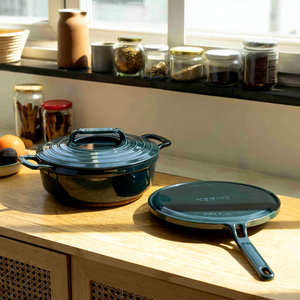
A ceramic frying pan (28-30 cm). The primary daily pan. Used for sabzi, eggs, sautéing, and most low-oil cooking.
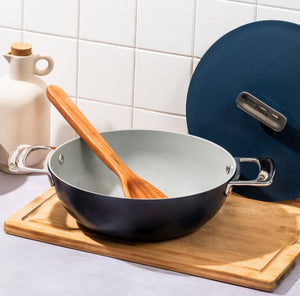
A ceramic kadai or saucepan. For wet dishes that need depth. Curry bases, gravies that start with sautéing, and dishes that need more volume than a frying pan provides.
A triply stainless steel pot. For dal, sambhar, acidic curries, and slow-cooked dishes. Low-oil cooking still works on stainless steel for these dishes because the cooking style is different.
A cast iron tawa. For rotis, parathas, and any dish where the seasoning provides natural release. Optional for households without dosa cooking, essential for those with it.
A pressure cooker. Standard for Indian efficiency cooking. Low-oil compatible by design because the cooking style does not depend on oil.
The four to five pieces together cover the full range of Indian cooking with low-oil performance across the board. Most households build this set gradually rather than buying it all at once.
FAQ: Best Cookware for Low-Oil Indian Cooking
Can I really cook Indian food with one teaspoon of oil?
For many everyday dishes, yes. Sabzi, eggs, sautéed paneer, and gentle frying all work at one teaspoon of oil on ceramic for a small to medium pan. Larger quantities or larger pans need proportionally more. Some dishes (tadka for sambhar, certain regional preparations, deep frying) require more oil to work as intended. The realistic goal is meaningful reduction across the daily cooking, not elimination across all cooking.
Is ceramic actually better than non-stick for low-oil cooking?
For Indian cooking patterns specifically, ceramic is more practical. Non-stick has excellent release at low oil but is less ideal for the high-heat cooking common in Indian kitchens. Ceramic provides comparable low-oil release without the high-heat coating concerns.
Will low-oil cooking work on regular stainless steel?
It can, with technique. Triply stainless steel works much better than single-layer. Even with triply, the technique requirement is real. Many cooks find low-oil cooking more sustainable on ceramic because the daily friction is lower.
Does low-oil cooking taste worse?
Initially, sometimes. The reduced browning, lighter mouthfeel, and less intense richness can take a few weeks to adjust to. After the adjustment period, most cooks find that food cooked in less oil tastes cleaner and lets the spice and vegetable flavours come through more clearly. Some dishes genuinely taste better with more oil, and the realistic approach is to identify which ones and keep traditional oil amounts for those.
Is olive oil better for low-oil cooking?
The oil type matters less than the amount for most home cooking. For Indian cooking specifically, traditional oils (mustard, sunflower, coconut, ghee) work well at low amounts. The choice of oil is more about flavour and heat tolerance than about quantity reduction.
Can I use ceramic for all my low-oil cooking?
For most of it, yes. Ceramic does not handle dosa, sustained high-heat work, or long-simmered acidic curries well. For those, other materials are better. For everyday low-oil cooking that makes up most home meals, ceramic does the bulk of the work.
How much oil do most Indian households actually use compared to what they need?
Significantly more than necessary, in many cases. Many traditional preparations specify oil amounts that were calibrated for older cooking styles, cookware that needed more oil to prevent sticking, and food preservation needs that no longer apply. Modern home cooking can often reduce oil by half or more without losing the quality of the food, especially with cookware that supports the lower amounts.
Will reducing oil meaningfully improve my health?
For people advised to reduce dietary fat or overall calorie intake, lower-oil cooking can support that goal. The health impact depends on the full diet and individual medical context, which is a question for medical professionals rather than cookware articles. The cookware choice supports whatever dietary change you have decided to make. The dietary change itself is between you and your doctor.
Bottom Line
Quality ceramic cookware is the most practical choice for daily low-oil Indian cooking. The release performance at minimal oil levels makes the transition sustainable in a way that other materials often do not.
Triply stainless steel and well-seasoned cast iron both work for low-oil cooking but ask more of the cook on technique. Non-stick can do low-oil cooking but is less ideal for high-heat Indian cooking patterns.
For many households trying to reduce oil meaningfully, the right ceramic pan removes enough daily friction to make the habit easier to maintain. A pan that releases food cleanly at one teaspoon of oil on a small to medium surface makes the dietary change easier to sustain across thousands of meals. The cookware investment pays back not in any single dish, but in whether the low-oil cooking habit becomes permanent.
The combination of a ceramic primary pan, a triply stainless steel pot for slow cooking, and a cast iron tawa for high-heat work covers a low-oil Indian kitchen well. Each material does what it does best, and the daily friction of low-oil cooking stays low enough that the habit holds.
