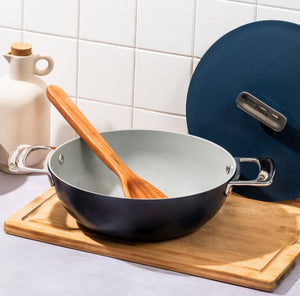
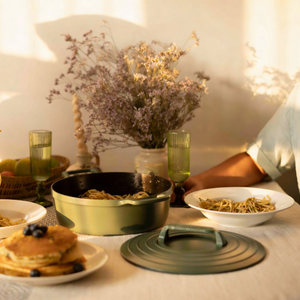
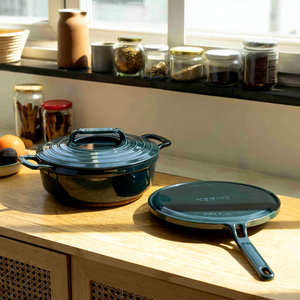


Direct answer: A working Indian kitchen needs four to five pieces, not ten or fifteen. The core set is a ceramic frying pan or kadai for everyday cooking, a triply stainless steel pot for dal and slow-cooked dishes, a cast iron tawa for rotis and dosas, and a pressure cooker for efficiency cooking. Some kitchens benefit from adding a ceramic saucepan or a coated cast iron pan as the fifth piece. The right starting point depends on what you already own and how you cook. Most Indian kitchens already have decent stainless steel and a pressure cooker. The common gaps are ceramic for everyday cooking and a proper cast iron tawa.
TL;DR
-
A working Indian kitchen needs four to five pieces, not a large set of matching cookware.
-
The four essentials are ceramic for everyday cooking, stainless steel for slow cooking, cast iron for high-heat work, and a pressure cooker for efficiency. Each one is indispensable for the cooking it handles.
-
Where to start depends on what you already own. Most kitchens have decent stainless steel and need to add ceramic and a good tawa.
-
Spend more on the pan you use every day. Spend less on pots you use occasionally.
-
Avoid buying matching sets. Build piece by piece across materials.
-
The most common mistake is buying redundant pieces in the same material instead of complementary pieces across materials.
Why Most Indian Kitchens Build Cookware Wrong
The default Indian cookware shopping pattern is to buy a matching set or to gradually accumulate pieces from the same material. A stainless steel set with three or four pots and pans. A non-stick set with multiple sizes. A complete kit purchased at marriage or housewarming. These setups look complete on the kitchen shelf but often leave gaps in the actual cooking.
The problem is that Indian cooking covers too wide a range of techniques and temperatures for any single material to handle well. A stainless steel set is excellent for dal, sambhar, and slow cooking but frustrating for sabzi and eggs. A non-stick set is convenient for eggs but raises high-heat concerns for everyday Indian cooking. A complete ceramic set looks beautiful but does not handle dosas or long-simmered acidic curries.
The kitchens that actually work are the ones that combine materials rather than committing to one. Each material does what it does best. The cook reaches for the right pan for the dish, not the only pan they own.
This is different from how cookware is usually marketed. Matching sets are easier to sell and easier to display, which is why they dominate the category. The buying decision they support is "buy this set and you are done." The reality of Indian cooking is that no single set finishes the job. Building the kitchen piece by piece across materials is slower but produces a working setup rather than an aesthetic one.
The Core Principle: Build for How You Cook
The right cookware set is the one that matches your cooking. This sounds obvious but is the step most buyers skip. They start with what looks complete or what is on sale, rather than with an honest assessment of what they actually cook.
Three questions answer most of the decision:
What do you cook every day? Whatever shows up on your stove most often should drive your primary pan choice. For most Indian households, this is sabzi and eggs, which favours ceramic. For households doing daily dosa, the primary need shifts toward cast iron. For households that cook mostly dal and acidic curries, stainless steel does more of the work.
What frustrates you about your current cookware? This is where the next purchase should go. If food sticks every time you cook sabzi on stainless steel, a ceramic pan addresses the daily frustration. If your dosa never works on a flat ceramic pan, a cast iron tawa is the missing piece. If you have no good pot for dal, a triply stainless steel pot is the gap.
What do you not cook that you would like to? Sometimes the cookware is what limits the cooking. People who never make dosa often discover that the reason was the lack of a cast iron tawa, not the lack of skill. People who avoid eggs often switch back once they own a pan that releases them cleanly.
The cookware set that fits these answers is usually smaller than buyers expect. Four pieces is enough for most Indian kitchens. Five if the household has specific needs (large family, frequent entertaining, regional cooking that requires specialised pots).
The Five Essential Pieces for a Working Indian Kitchen
Here are the pieces that genuinely earn their place in most Indian kitchens. Each one is indispensable for the cooking it handles. Pieces beyond this list are situational rather than essential.
1. Ceramic frying pan or kadai (28-30 cm). The daily pan for everyday cooking. Used for sabzi, eggs, sautéing, low-oil cooking, and most everyday Indian dishes. This is the pan that does the most volume in a typical Indian kitchen, which is one reason it is worth spending more on. Indispensable for the daily cooking that other materials make harder than it needs to be.
2. Triply stainless steel pot (3-4 litres). The workhorse for slow and acidic cooking. Dal, sambhar, tamarind-based curries, boiling rice, and any cooking that benefits from non-reactivity. Indispensable for the cooking ceramic cannot do without damaging the coating. A well-made triply stainless steel pot is one of the longest-lasting investments in any kitchen, often outliving the household that bought it.
3. Cast iron tawa (28-30 cm). The high-heat specialist. Rotis, parathas with proper browning, and dosas all rely on cast iron's heat retention and high-temperature tolerance. Indispensable for the cooking ceramic is not built for. Even households that mostly cook on other materials benefit from owning one cast iron tawa for the specific tasks where nothing else performs as well.
4. Pressure cooker (3-5 litres). Already in most Indian kitchens. Used for rice, dal, beans, certain curries, and any cooking where the time savings matter. Stainless steel pressure cookers are the standard. Indispensable for Indian efficiency cooking and the foundation of most weekday meal preparation.
5. Optional fifth piece, depending on the household:
-
A ceramic saucepan for households that want depth for curry bases and gravies that ceramic handles well at the start
-
A coated cast iron pan (TitaniumClad, enamel) for households that want cast iron's heat performance without the seasoning learning curve
-
A larger stainless steel pot for households that cook for more than four people regularly
-
A small non-stick pan reserved for low-heat egg cooking, if the household already owns one in good condition
These five pieces handle the full range of Indian cooking. Adding more cookware usually adds storage problems rather than cooking capability.
What to Buy First If You Are Starting From Scratch
For someone setting up a kitchen with no existing cookware, the order matters because each piece serves different cooking immediately.
Buy these in this order:
-
Pressure cooker first. This is the highest-impact single purchase because of the volume of cooking it covers (rice, dal, vegetables, certain meats). A 3-litre stainless steel pressure cooker handles most household needs.
-
Triply stainless steel pot second. This handles the dal, sambhar, and slow cooking that the pressure cooker is overkill for. A 3-litre pot works for daily cooking. A 5-litre option works for households that cook in larger quantities.
-
Ceramic frying pan third. This is the pan you will use most often once you have it. Buying this third lets you defer the expense until the first two essentials are in place, while still getting to it before you have built up too many compromises with worse pans.
-
Cast iron tawa fourth. The slowest to season and the most specific in use, but essential for rotis, parathas, and dosas. Even if you do not cook dosa, the cast iron tawa makes parathas and rotis better than any alternative.
-
Optional fifth piece based on how the kitchen settles into use after the first four are working.
This order matters because each piece adds a new cooking capability rather than duplicating one. Buying two ceramic pans before owning a stainless steel pot leaves the kitchen unable to make dal properly. Buying three pieces of cast iron before owning ceramic leaves daily sabzi cooking on the wrong material.
What to Buy First If You Are Upgrading From Old Cookware
Most readers of this article already own some cookware. The question is what to add, not what to start with. The cultural reality here is worth naming: most Indian kitchens are not built from scratch. They evolve across generations. Pressure cookers are inherited from parents. Stainless steel accumulates across years of weddings, housewarmings, and gradual purchases. Cast iron sometimes comes from grandparents. The buying question for most households is what to add to an inherited and accumulated setup, not what to buy first in an empty kitchen.
The honest assessment of what most Indian kitchens have and need is usually:
You probably have decent stainless steel and a pressure cooker already. Most Indian kitchens do. These are the pieces that get passed down, gifted, and accumulated over years. If your stainless steel pot is in good condition, you do not need to replace it.
You probably do not have premium ceramic. This is one of the most common gaps. The everyday cooking that should be effortless feels harder than it needs to be because the existing options (stainless steel, old non-stick, or cheap ceramic that has failed) are not suited to it. Adding one premium ceramic pan addresses the gap and often becomes the most-used pan in the kitchen within weeks.
You may not have a dedicated cast iron tawa. This is the other common gap. Many kitchens have a generic tawa that works for rotis but not for dosa. A proper cast iron tawa with enough seasoning handles both well. If your current tawa is failing for dosa or feels like a compromise for everything, this is a real upgrade.
You may have old non-stick that needs replacing. Pre-2013 non-stick has the PFOA concern. Even post-2015 non-stick has reached the end of its useful life within a few years of regular use. If your non-stick is more than five years old or visibly damaged, replacing it with ceramic is the simplest upgrade path.
The order for upgrading buyers is usually:
-
Whichever of ceramic and cast iron tawa is the more pressing gap. For households that cook daily sabzi without a good non-stick pan, ceramic first. For households that struggle with dosas or parathas, cast iron tawa first.
-
The other of those two pieces, once the more pressing one is in place.
-
Triply stainless steel pot if your existing one is single-layer and frustrating.
-
Optional fifth piece based on what is still missing.
Adding both ceramic and a proper cast iron tawa to an existing kitchen changes the day-to-day cooking experience most noticeably. Each piece addresses cooking that the other materials in the kitchen cannot do well.
Common Mistakes When Building a Cookware Set
Several patterns show up consistently in Indian kitchens that have ended up with the wrong cookware.
Buying a complete matching set. The set looks impressive but contains pieces you will rarely use and missing pieces you actually need. A four-piece ceramic set has no stainless steel pot, no cast iron tawa, and no pressure cooker. A six-piece stainless steel set has no ceramic and no cast iron. Starter sets can work for some buyers if they understand what they still need to add later, but the all-in-one promise that most matching sets make is usually incomplete for Indian cooking.
Buying multiple sizes of the same pan. Two ceramic pans of different sizes is a less useful purchase than one ceramic pan and one cast iron tawa. The diversity matters more than the size range. Most cooking happens in two or three pieces, not five or six.
Buying cheap ceramic to save money. Many low-cost ceramic pans fail within months. The money spent ends up worse than the same money spent on mid-range stainless steel or premium ceramic. The cheapest path to non-stick cooking is not the cheapest ceramic. It is the ceramic that lasts long enough to justify the purchase.
Buying premium versions of pots you barely use. A premium stainless steel stock pot is wasted money if you make stock twice a year. The premium investment belongs in the pan you use every day. A mid-range pot for occasional use is fine.
Buying for aesthetics rather than cooking. Cookware that looks beautiful on the shelf but performs poorly is a common pattern, especially with copper-bottomed pans and decorative cast iron. The cookware that earns its place is the cookware that does the cooking well, not the cookware that displays best.
Stocking up on non-stick. A kitchen with three non-stick pans is over-invested in a category that has known concerns for Indian cooking patterns. One non-stick pan reserved for low-heat eggs is fine. More than that is buying into a material that does not match the cooking style.
What You Do Not Need
The cookware marketing industry pushes pieces that most Indian kitchens never use. Worth being clear about what falls into this category.
A separate omelette pan. A small ceramic frying pan does omelettes well. A dedicated omelette pan is a specialty piece that solves a problem most kitchens do not have.
A dedicated grill pan. Tandoor and outdoor grills handle the cooking grill pans were designed for. A grill pan in an Indian kitchen mostly sits in the cupboard.
Multiple sizes of saucepan. One ceramic saucepan and one stainless steel pot is enough for almost every household. Three saucepans is two too many.
A wok separate from a kadai. A good kadai handles most stir-frying tasks. A separate wok is useful for Chinese-style cooking but does not earn its place in a kitchen primarily cooking Indian food.
Specialty pieces for one dish. Idli stands, appam pans, and similar pieces are essential if you cook those specific dishes regularly. They are otherwise dust collectors. Buy them only if the dish is part of your regular cooking, not because the set looked complete with them included.
Multiple matching cookware sets. Owning more than one set is a common pattern that adds cost without adding capability. One set per kitchen is plenty.
Why This Matters Even More in Smaller Kitchens
Indian urban kitchens are often small. Apartment kitchens in Mumbai, Bangalore, Delhi, and most other Indian cities are space-constrained by design. Counter space is limited. Shelf space is finite. Cookware that does not get used regularly takes up room that better-used cookware could occupy.
This is part of why the four-to-five piece framework matters more in Indian kitchens than the same framework would matter in a larger home elsewhere. Twelve mediocre pieces compete for storage with each other and with the rest of the kitchen. Four well-chosen pieces fit comfortably and get used daily.
The storage problem compounds over years. The pan bought because it was on sale, the set received as a wedding gift, the specialty piece bought for one dish never made again. Each one takes up shelf space that more useful cookware could occupy. The cumulative cost of redundant cookware is not just money. It is the daily inconvenience of working around pieces that do not earn their place.
Multi-material thinking helps here. Four pieces across four different materials cover more cooking than four pieces of the same material. The diversity is what makes the small set sufficient. A kitchen with one ceramic pan, one stainless steel pot, one cast iron tawa, and one pressure cooker can produce the full range of Indian cooking in less storage space than a single-material set of equivalent piece count.
For smaller kitchens specifically, the multi-material framework is not just a cooking preference. It is a storage strategy.
Budget Allocation: Where to Spend More, Where to Spend Less
The total cookware budget matters less than how it is allocated. A ₹15,000 budget spent badly produces a worse kitchen than a ₹12,000 budget spent well.
Spend more on the pan you use every day. This is almost always the ceramic frying pan. Premium ceramic costs three to four times what cheap ceramic costs and lasts five to ten times longer. The daily cooking is also where the pan quality affects your experience most directly. This is the piece where the premium investment pays back clearly.
Spend a moderate amount on the stainless steel pot. Triply stainless steel from a reputable brand handles dal and slow cooking well without needing the absolute highest tier. The cooking style is more forgiving of small variations in cookware quality than ceramic is.
Spend modestly on the cast iron tawa. A good cast iron tawa from a mid-range Indian brand performs comparably to expensive imports for most home cooking. The performance differences at the cast iron premium tier are smaller than the marketing suggests.
Spend appropriately on the pressure cooker. Stainless steel pressure cookers from established Indian brands are excellent and do not need a premium tier purchase. The category is mature, and the quality is reliable across most price points.
Save the budget for what matters by skipping what does not. Each piece you do not buy frees budget for the pieces you do. A household that skips the unnecessary omelette pan, grill pan, and second saucepan has more budget to spend on a premium ceramic pan that will be used every day.
A Note on Premium Versus Mass-Market Choices
For ceramic specifically, the premium versus mass-market gap is meaningful. A premium ceramic pan can deliver years of useful life. A mass-market ceramic pan often does not survive past the first year.
Ember's ceramic cookware is manufactured in Italy. Italian ceramic manufacturers have a long history in the category, which tends to produce more consistent coatings than mass-market manufacturing. The Arcilla coating is mineral-based and independently tested and certified by SGS, free of PTFE, PFOA, PFAS, lead, and cadmium. This is one example of premium ceramic in the Indian market. Other brands meeting similar standards exist.
The point is not that one brand is the only option. It is that the premium ceramic decision is the single most consequential cookware purchase in most Indian kitchens, and verifying the manufacturer's certifications matters more than the specific brand chosen. The same verification criteria apply across brands: independent testing certifications, transparent coating composition, established manufacturing origin.
For stainless steel, the premium tier is less differentiated. Triply construction from any reputable brand performs well. The brand differences at this tier are more about handles, balance, and aesthetics than about cooking performance. Single-layer stainless steel works for cooking and is what millions of Indian households use every day successfully. It is less forgiving than triply on low-oil cooking, with more heat unevenness to manage, but it is not unusable.
For cast iron, mid-range Indian brands often outperform expensive imports for typical home cooking. The category does not benefit from premium pricing the same way ceramic does.
The allocation principle holds: spend the premium dollars where the difference shows up in daily use, and spend modestly where it does not.
FAQ: Building a Cookware Set for an Indian Kitchen
How many pieces does an Indian kitchen actually need?
Four to five pieces is enough for most households. A ceramic frying pan, a triply stainless steel pot, a cast iron tawa, and a pressure cooker handle the full range of Indian cooking. A fifth piece (ceramic saucepan, coated cast iron, larger pot) is useful but optional.
What is the single best piece to add to my existing kitchen?
For most Indian kitchens that already own stainless steel and a pressure cooker, the two most common gaps are ceramic and a proper cast iron tawa. Which one to add first depends on what frustrates you more in your current cooking. If sabzi and eggs are the daily friction, start with ceramic. If dosas and parathas are not coming out well, start with cast iron.
Should I buy a complete cookware set?
Generally no. Matching sets contain pieces you do not need and miss pieces you do need. Starter sets can work if you understand they are not a complete solution and plan to add specific pieces later. Buying piece by piece across materials produces a more useful kitchen than buying any single matching set.
How much should I spend on a primary cookware set?
The total budget depends on what you already own and what you are building. For a complete set bought from scratch, ₹15,000 to ₹25,000 covers the four essentials at quality that will last. For most upgrade purchases (adding one or two pieces), ₹5,000 to ₹10,000 is enough.
Is it worth buying premium ceramic over mid-range ceramic?
For households cooking daily, yes. Premium ceramic lasts five to ten times longer than mid-range, which makes the cost-per-use math favourable even at higher upfront prices. For households cooking occasionally, the case is weaker. Mid-range ceramic from a reputable brand can be sufficient for lighter use.
Do I need both stainless steel and ceramic?
For most Indian households, yes. Stainless steel handles cooking ceramic does not (slow cooking, acidic curries, boiling). Ceramic handles cooking stainless steel makes harder (sabzi, eggs, low-oil cooking). The two materials are complementary rather than competitive.
Should I include any non-stick in my new cookware set?
Optional. If you already own non-stick in good condition (post-2015, intact coating), reserving it for low-heat egg cooking is fine. Buying new non-stick for an Indian kitchen is less compelling than buying ceramic, which handles the same low-oil tasks without the high-heat coating concerns.
How long should a complete cookware set last?
Stainless steel and pressure cookers should last decades. Cast iron should last decades, often a lifetime. Premium ceramic should last several years of daily use, often longer. The cookware set as a whole, if built well, should last fifteen to twenty years before any piece needs replacing, with most pieces lasting much longer.
What if I do not cook dosa? Do I still need cast iron?
Cast iron is still useful even without dosa. It handles parathas with better browning than ceramic, supports high-heat tadka work, and offers versatility ceramic does not. A cast iron tawa is worth owning even for households that never make dosa. That said, if dosa is not part of your cooking and budget is tight, cast iron can be the piece deferred longest in the buying order.
Can I just buy everything from one brand?
You can, but you usually end up with compromises. Most brands are stronger in one material than another. A brand known for ceramic may have weaker stainless steel options. A brand known for stainless steel may not produce premium ceramic at all. Mixing brands by material tends to produce a better-performing kitchen than committing to one brand across materials.
Bottom Line
A working Indian kitchen needs four to five well-chosen pieces, not a large matching set. Ceramic for everyday cooking, stainless steel for slow cooking and acidic dishes, cast iron for high-heat work, and a pressure cooker for efficiency cooking together cover the full range of Indian home cooking. Each material is indispensable for the cooking it handles.
The right starting point depends on what you already own. Most Indian kitchens have decent stainless steel and a pressure cooker. The common gaps are premium ceramic and a good cast iron tawa. Adding those two pieces changes the day-to-day cooking experience most noticeably, with each one addressing cooking that the other materials in the kitchen cannot do well.
The budget allocation matters more than the brand. Spend more on the pan you use every day. Spend less on pots you use occasionally. Skip the pieces that look complete on a shelf but never get used in practice. The cookware that earns its place is the cookware that does the cooking, not the cookware that displays best.
The kitchens that work are usually the ones built piece by piece across materials, rather than the ones built in matching sets. Slower to assemble. Faster to cook in once assembled. The difference is whether the cookware was chosen to look complete or chosen to work.
